Heatwave strains UK rail network, causing
Record summer heat is buckling tracks and drying soil, causing derailments and service disruptions across Britain's railways built for a cooler climate.
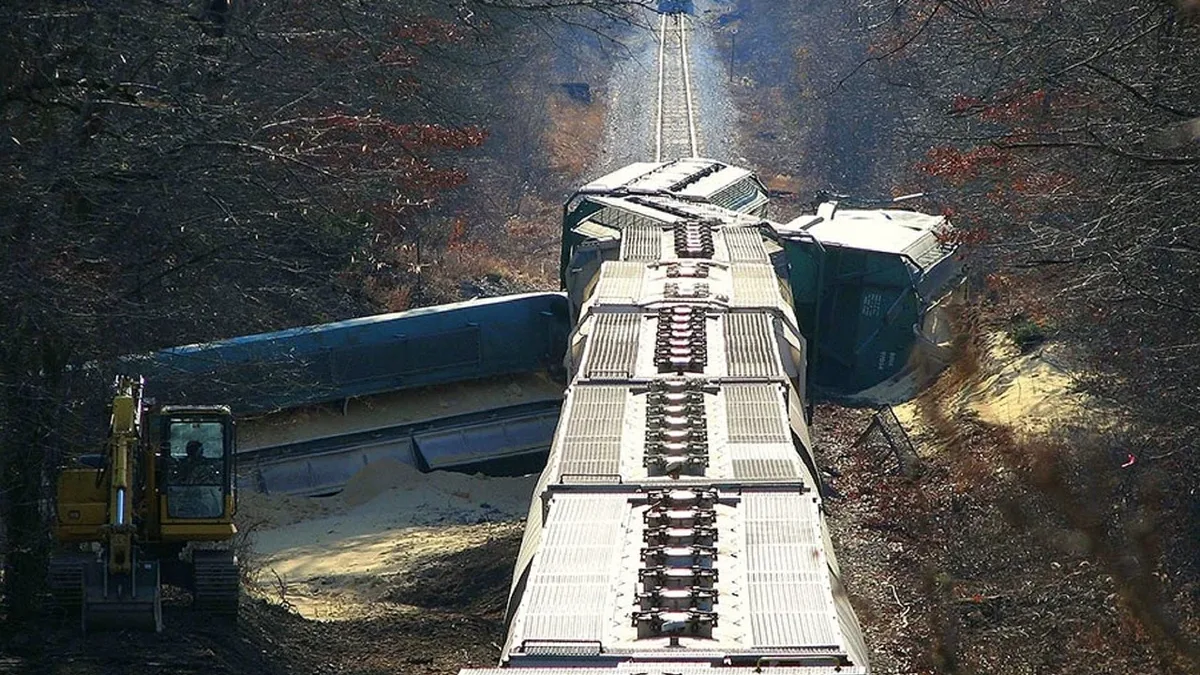
Britain's railways have faced a string of heat-related problems this summer, including two derailments. One near Lewes in East Sussex injured 30 people, and another at Wickford station in Essex saw carriages derail with no reported injuries. Network Rail said the hot, dry summer has presented exceptional challenges to the railway.
Steel expands when it gets hot. The long, welded sections that make up modern railway tracks are no exception. "The classic concern for railways with hot weather is that the track might buckle," said William Powrie, a professor at the University of Southampton. As temperatures rise, the rails expand. Their continuous design means there is little room for movement. "If they haven't got anywhere to go, they end up generating compressive stresses," Powrie explained. "The problem with any sort of structure which has got a compression in it is that it can fail by buckling."
How heat damages the track
The consequences can be serious. A 2022 heatwave led to almost 7,700 cancelled trains and an estimated £30m in costs, according to a Network Rail taskforce. On a hot day, the rail can reach much higher temperatures than the air. Network Rail says most of the network can operate when track temperatures reach up to 46C, roughly equivalent to an air temperature of 30C. But rails have been recorded at temperatures as high as 51C.
The sleepers and ballast that rails sit on can help stop them from buckling. Long periods of heat and drought can dry the soil beneath them. That soil can shrink when it dries. Manu Sasidharan, an assistant professor at University College London, noted this is a problem given the soil "is essentially the foundation for anything on top of it". The weight of passing trains makes the problem worse, putting pressure on the weakened soil and causing it to settle unevenly. Whatever sits on top, including the track, "will follow suit", Sasidharan said.
Adapting railways for a hotter climate
To stop rails from buckling, engineers lay them slightly stretched, a process called pre-stressing. In the UK, rails are stretched so that they do not undergo compression until the air temperature passes 27C. Other countries set that figure differently. The so-called stress-free air temperature can exceed 35C in parts of Australia and the US. In southern Europe, rails are designed for more heat since there's less risk of the rail snapping in the cold.
"If you're looking at Italy, where you don't really get very low winter temperatures, then you can afford to increase the stress-free temperature," Powrie said. "The problem is the range of temperatures that we have [in the UK] ..." One theoretical option is to re-stress rails between seasons. Network Rail says variations in Britain's weather mean this is neither practical nor cost-effective to implement permanently.
Another option is to lay track on solid concrete slabs, rather than the more common bed of sleepers and ballast. However, slab track costs about four times as much to install as standard ballasted track.
| Adaptation Measure | Description | Cost/Consideration |
|---|---|---|
| Increase stress-free temperature | Raising the temperature at which rails begin to compress, e.g., from 27C to 30C. | Leaves rails more vulnerable in a cold snap. |
| Seasonal re-stressing | Loosening and retensioning rails between summer and winter. | Deemed neither practical nor cost-effective for the UK by Network Rail. |
| Slab track | Laying track on solid concrete slabs instead of ballast. | Costs about four times as much to install as standard ballasted track. |
| Painting tracks white | Reduces heat absorption. | A rail painted white is typically 5-10C cooler, according to Network Rail. |
Simpler measures are already in use. Some sections of track are painted white to reduce how much heat they absorb. Network Rail says a rail painted white is typically 5-10C cooler. Both tactics may be necessary as summers get hotter. All five of the UK's warmest summers on record have happened since 2000, according to the Met Office.
Monitoring for faults remains difficult. The Network Rail taskforce found that fewer than half of the track buckles recorded in 2022 had been identified before they happened. Part of the issue is the sheer amount of data modern trains generate. Many now carry sensors, but sifting through it all is a challenge that needs to be automated, experts say. Much still relies on judgment, such as a train driver detecting rough riding and reporting it. As a temporary measure, speed restrictions were imposed on trains in southern Essex after the Wickford derailment.
Investigating the Lewes derailment
It is impossible to say for sure if the Lewes derailment happened because of the heat. An interim report by the Rail Accident Investigation Branch (RAIB) found that a "track geometry irregularity" existed before the derailment. Investigators had received reports of rough riding from passengers on that stretch of line. Sasidharan said early evidence pointed to the track itself. "The initial indication of the derailment ... is that it's a track infrastructure fault, most likely," he said.
At the site, the embankment is built on clay, which shrinks more than other types of soils as it dries out. The RAIB said the clay was "sensitive to variations in water content". There was evidence it had shifted before the derailment, though not enough to amount to a significant slip. Powrie said the location had several things working against it at once. This makes it a case of the "Swiss cheese" theory of accidents, where one only happens when several small failures line up. The derailment happened on a bend and close to where the track leaves a bridge and moves on to the embankment. Powrie said these transition points were a natural weak spot. The track had to cope with a sudden change from something rigid to ground that could shift, especially when dried out. "It wouldn't surprise me if the defect turned out to be related to the dryness," he said, "but I don't really want to speculate." Network Rail has said it is fully committed to supporting the continuing investigation.