Humpback whale vessel strike injuries rise on Australia's east coast
New images reveal fresh propeller wounds on humpback whales off Australia's east coast.
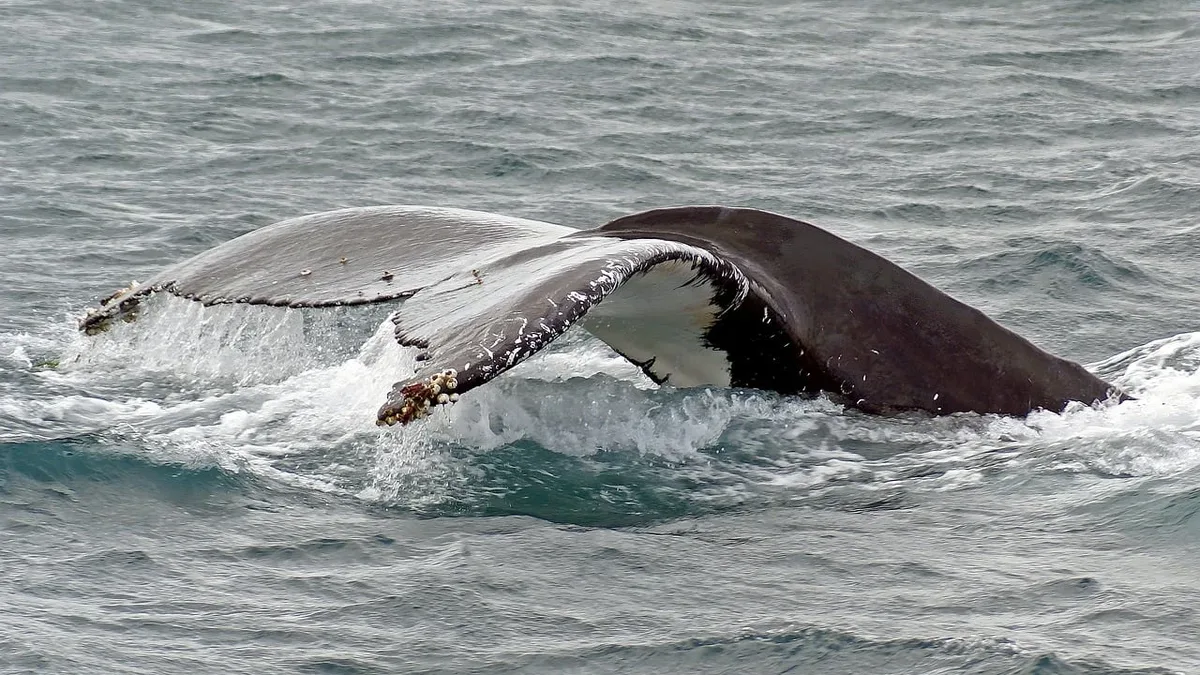
Fresh propeller injuries are being documented on humpback whales migrating along Australia's east coast. The population has rebounded from fewer than 300 in the 1960s to an estimated 40,000-50,000 whales today, but this success is now shadowed by increased vessel strike risks where whale migration paths overlap with heavy boat traffic.
New images show fresh propeller wounds on humpback calves and adults along Australia's east coast. On 13 September 2026, citizen scientist Isabel Taylor photographed a humpback calf with broad, fresh cuts on its back in Hervey Bay, Queensland. Just weeks later, on 27 September, she documented blunt force trauma to another calf's tail in the same bay. The mother of the first injured calf has been known to researchers since 2004. Another subadult humpback with propeller injuries was filmed in Hervey Bay on 28 August by Silke Stuckenbrock, a deckhand and citizen scientist.
Further south, a drone captured footage on 21 June 2026 of a humpback with lacerations and exposed red flesh off Sydney's Bondi Beach. These recent incidents echo a longer history of injury. A female humpback known as Bladerunner, reportedly injured off Sydney in 2001, continues to migrate with extensive propeller scars. She was filmed off Eden on 28 September 2024.
Context - Recovery and a New Collision Course
Humpback whaling was banned in the southern hemisphere in 1963, though illegal Soviet hunting continued into the early 1970s. From a low of 200-500 animals in 1962, the east coast population has made a remarkable recovery.
| Year | Estimated East Coast Humpback Population |
|---|---|
| 1960s | Less than 300 |
| 2004 | Approximately 7,800 |
| 2015 | Around 25,500 |
| Present | 40,000-50,000 |
This resurgence now coincides with intense coastal boat traffic. More than 970,000 boats are registered in Australia, with over half a million in Queensland and New South Wales alone. One in ten Australians holds a boat licence. Experts note that migrating humpbacks surface predictably and often cannot avoid fast-approaching vessels.
Response - A Global Priority and Local Solutions
On Friday 2 October, the International Whaling Commission passed a resolution declaring vessel strikes an increasing global problem and a priority concern. The resolution calls for safer shipping routes, slower speeds in high-risk areas, and better reporting to reduce collisions. The IWC acknowledges most collisions go unseen and unreported.
Dr Raphael Mayaud, a marine ecologist advising the IWC, stated, "These images really bring home the physical and direct impact we’re having on these animals, especially on animals that size." The World Wide Fund for Nature (WWF) is pushing for a formal vessel strike plan developed with communities, science, NGOs, industry, and government.
Injuries can be devastating even when not immediately fatal. If a whale loses part of its fluke, swimming becomes less efficient. This drains energy, affecting migration, feeding, and potentially reproduction. Survivors may endure long-term pain, infection, and trauma.
Mitigation Efforts - From AI to Accountability
Globally, other whale collision hotspots are testing solutions. In California, shipping companies are scored on public scorecards for complying with seasonal speed limits. San Francisco Bay is trialling AI-assisted whale-spotting cameras to warn ship captains. In Australia, while reporting collisions with protected species is legally required, most go undocumented. Citizen scientists are filling this gap by sharing evidence to raise awareness.
Isabel Taylor observed the behaviour of the injured calf and its mother, noting, "The others were very surface active and putting on a show, but this other mum and calf were more reserved." Experts are calling for a coordinated vessel strike plan to protect the migrating humpbacks their conservation success has brought back.